
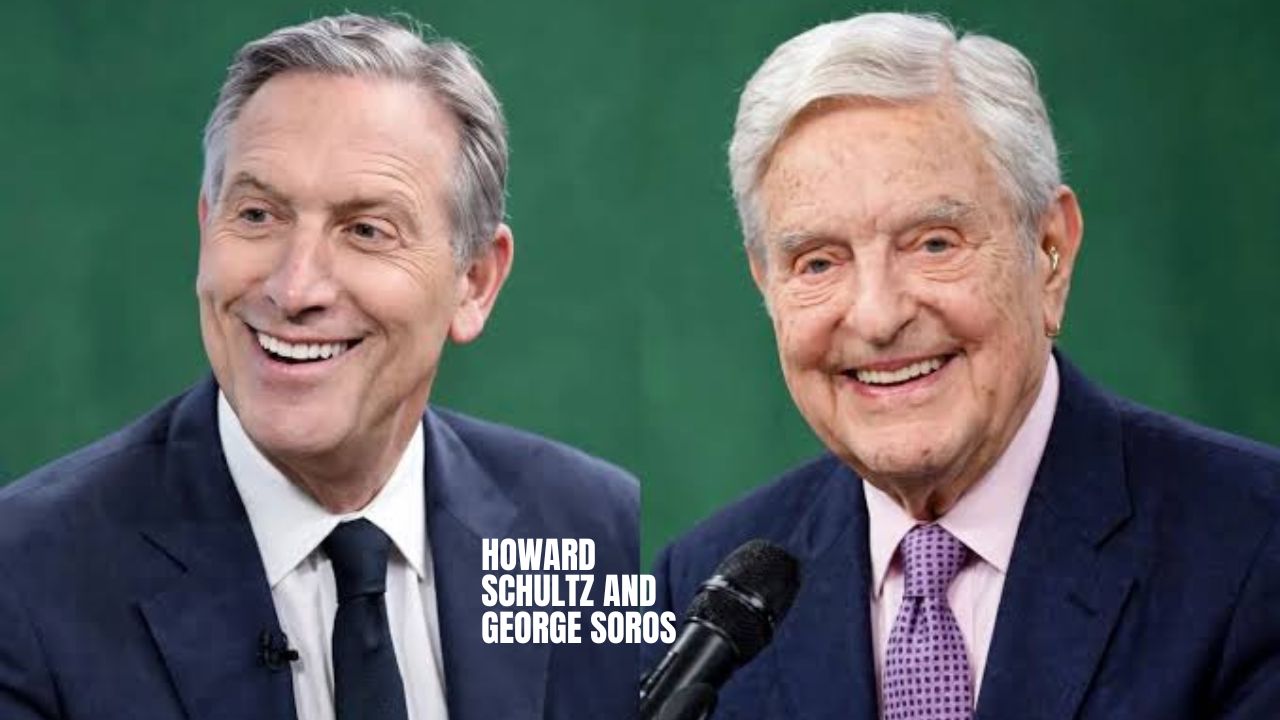
Howard Schultz and George Soros are prominent figures known for very different reasons. Schultz built his reputation in the coffee industry through his leadership at Starbucks, while Soros became widely known for his investment career and international philanthropic activities. Their names intersect in a political episode involving American Bridge 21st Century, a Democratic-aligned political organisation.
Public records show that Soros contributed financially to American Bridge and that the organisation subsequently filed a federal election complaint concerning Schultz’s exploration of an independent presidential bid in 2019. The Federal Election Commission (FEC) eventually dismissed the allegation.
These events establish an indirect institutional connection, not proof of a personal dispute between the two men. The records discussed here identify American Bridge 21st Century and Bradley Beychok as the complainants. They do not establish that Soros personally directed the complaint or participated in the decision to file it.
1. Two Influential Figures With Different Professional Backgrounds
Howard Schultz: The Executive Behind Starbucks’ Expansion
Howard Schultz is widely associated with the growth of Starbucks from a coffee retailer into an internationally recognised brand.
He joined Starbucks in 1982, taking responsibility for retail operations and marketing. A trip to Italy the following year introduced him to the country’s espresso-bar culture and influenced his vision for creating a similar coffeehouse experience in the United States.
Schultz later established Il Giornale. In 1987, the company acquired Starbucks’ assets with support from investors and continued operating under the Starbucks name. This distinction is important because Starbucks had originally opened in 1971, before Schultz became involved. His role was central to the company’s subsequent expansion and development.
Over the years, Schultz served multiple terms as chief executive, helping shape the company’s business strategy and public identity. Following his final period as interim CEO, he left Starbucks’ board in September 2023 and became chairman emeritus.
His later consideration of an independent presidential campaign brought him into a political debate that extended well beyond the business world.
George Soros: An Investor Who Established a Global Philanthropic Network
George Soros developed his wealth through financial markets and subsequently became a major figure in international philanthropy.
Born in Hungary in 1930, Soros studied at the London School of Economics before moving to the United States in 1956. He established his own hedge fund in 1970, beginning the investment career that would make him a prominent financial figure.
His philanthropic work began in 1979, when he funded scholarships for Black South Africans living under apartheid. Over time, these efforts developed into the network now known as the Open Society Foundations.
The organisation describes its mission in terms of supporting human rights, justice, equality and open societies. Its activities span numerous countries and policy areas.
Although these details explain Soros’s broader public profile, his relevance to the Schultz story is more specific: financial support for an organisation that later became involved in a federal election complaint concerning Schultz.
2. The Political Organisation at the Centre of the Story
American Bridge 21st Century provides the documented link between Schultz and Soros.
The organisation is associated with Democratic political activity and conducts opposition research, a practice that involves gathering and analysing information about political figures and their records.
Reporting by the Center for Public Integrity identified Soros as one of the organisation’s significant financial supporters. Federal campaign-finance records provide further documentation of that relationship, including a contribution recorded in American Bridge’s 2017 filings.
The organisation subsequently became involved in a dispute concerning Schultz’s possible presidential candidacy.
In February 2019, American Bridge filed a complaint with the FEC, questioning whether Schultz’s political activities had reached the point at which he was required to register and report as a federal candidate.
The sequence of events establishes the connection between the three parties: Soros financially supported American Bridge, and American Bridge later challenged Schultz’s compliance with campaign-finance requirements.
However, a donation to an organisation does not automatically establish that the donor controlled its decisions. The available records do not demonstrate that Soros ordered, approved or personally coordinated the complaint against Schultz.
3. Why Schultz’s 2019 Presidential Ambitions Drew Attention
The political controversy began when Schultz publicly discussed the possibility of entering the 2020 U.S. presidential election as an independent candidate.
During an interview on CBS’s 60 Minutes on January 27, 2019, Schultz said he was seriously considering a centrist presidential campaign. His proposal attracted attention because he would have sought the presidency outside the traditional Democratic and Republican nomination processes.
The prospect concerned many Democrats. Some feared that an independent candidate with Schultz’s name recognition and financial resources could attract voters who might otherwise support the eventual Democratic nominee, potentially benefiting then-President Donald Trump.
That concern reflected a political calculation about how an independent campaign might affect the election. It was not proof that Schultz would necessarily have changed the election’s outcome.
Schultz ultimately decided against running. On September 6, 2019, he announced that he would not pursue the presidency, citing several considerations, including the political circumstances and health issues that had disrupted his plans.
As a result, the episode involved a possible candidacy rather than a completed independent presidential campaign.
4. Inside the Federal Complaint Filed Against Schultz
The Main Question Was Whether He Had Become a Candidate
American Bridge’s complaint, filed on February 7, 2019, became part of the FEC’s Matter Under Review 7567.
The central allegation was that Schultz’s activities had progressed beyond preliminary consideration of a presidential run. According to the complaint, he should therefore have registered with the commission and complied with the applicable financial disclosure and reporting rules.
The FEC’s general counsel examined activities described in the record, including the hiring of political consultants, polling and preparations related to potential paid advertising.
These activities formed part of the dispute over whether Schultz was still exploring his options or had crossed the legal threshold for becoming a candidate. The allegations themselves were not findings that he had violated federal law.
Campaign-finance rules recognise that individuals may investigate the possibility of running for office before formally deciding to campaign. Such preliminary work, often described as testing the waters, can involve research, polling, travel and consultations.
Whether a person has moved beyond that exploratory stage depends on the relevant facts and circumstances. The mere existence of political preparations does not, by itself, resolve the legal question.
The FEC Closed the Case Without Pursuing the Allegation
The commission’s handling of the matter is essential to understanding the outcome.
According to the FEC’s certification dated November 9, 2021, commissioners recorded two unsuccessful 3–3 votes on motions involving proposed analyses of the case. They subsequently voted unanimously, 6–0, to dismiss the allegation and close the file.
The voting record requires some nuance. The unanimous dismissal did not mean every commissioner agreed on all aspects of the legal reasoning or the proposed analyses considered earlier.
A separate statement from three commissioners explained their view that the available record did not establish that Schultz’s spending had exceeded permissible exploratory activities.
The final outcome is therefore clear: the FEC dismissed the matter and closed the case. The original complaint should not be presented as proof that Schultz committed a campaign-finance violation.
5. Separating Documented Events From Unproven Claims
The relationship between Schultz and Soros is best understood by examining each part of the story independently.
First, the financial relationship: Federal records document Soros’s contributions to American Bridge 21st Century.
Second, the political action: American Bridge filed a complaint concerning Schultz’s activities while he was considering an independent presidential campaign.
Third, the regulatory decision: The FEC dismissed the allegation and closed the matter in 2021.
Taken together, these facts establish an indirect connection through a political organisation and a federal election dispute.
They do not establish that Schultz and Soros were personal adversaries, that they had a direct confrontation, or that Soros personally initiated the complaint. Such conclusions would require additional evidence, such as authenticated communications or reliable testimony directly connecting Soros to the filing decision.
Similarly, the available material does not establish a business partnership, shared commercial venture or family relationship between the two men. This means that no such relationship has been demonstrated by the sources examined here; it does not prove that they have never met or interacted privately.
Distinguishing documented facts from assumptions is particularly important when political figures and major donors appear in the same story. Financial support for an organisation and responsibility for a particular action are separate questions.
6. What the Schultz–Soros Connection Actually Reveals
The public record offers a specific explanation for why Howard Schultz and George Soros are sometimes discussed together.
Soros contributed to American Bridge 21st Century. The organisation later filed a federal election complaint concerning Schultz’s exploration of a possible independent presidential campaign. The FEC reviewed the matter and ultimately dismissed the allegation.
That chain of events provides a documented institutional connection, but it does not establish a direct personal relationship or prove that Soros controlled the organisation’s actions.
Schultz’s business career, Soros’s financial and philanthropic activities, and American Bridge’s political work are distinct subjects. Their intersection in this case should not be mistaken for evidence of a broader personal or commercial alliance.
The most defensible conclusion is straightforward: Howard Schultz and George Soros are indirectly connected through American Bridge 21st Century and the 2019 campaign-finance complaint involving Schultz. The subsequent dismissal by the FEC is an equally important part of that history.
Keeping these details in context allows readers to understand the political connection without overstating what the available evidence proves.