
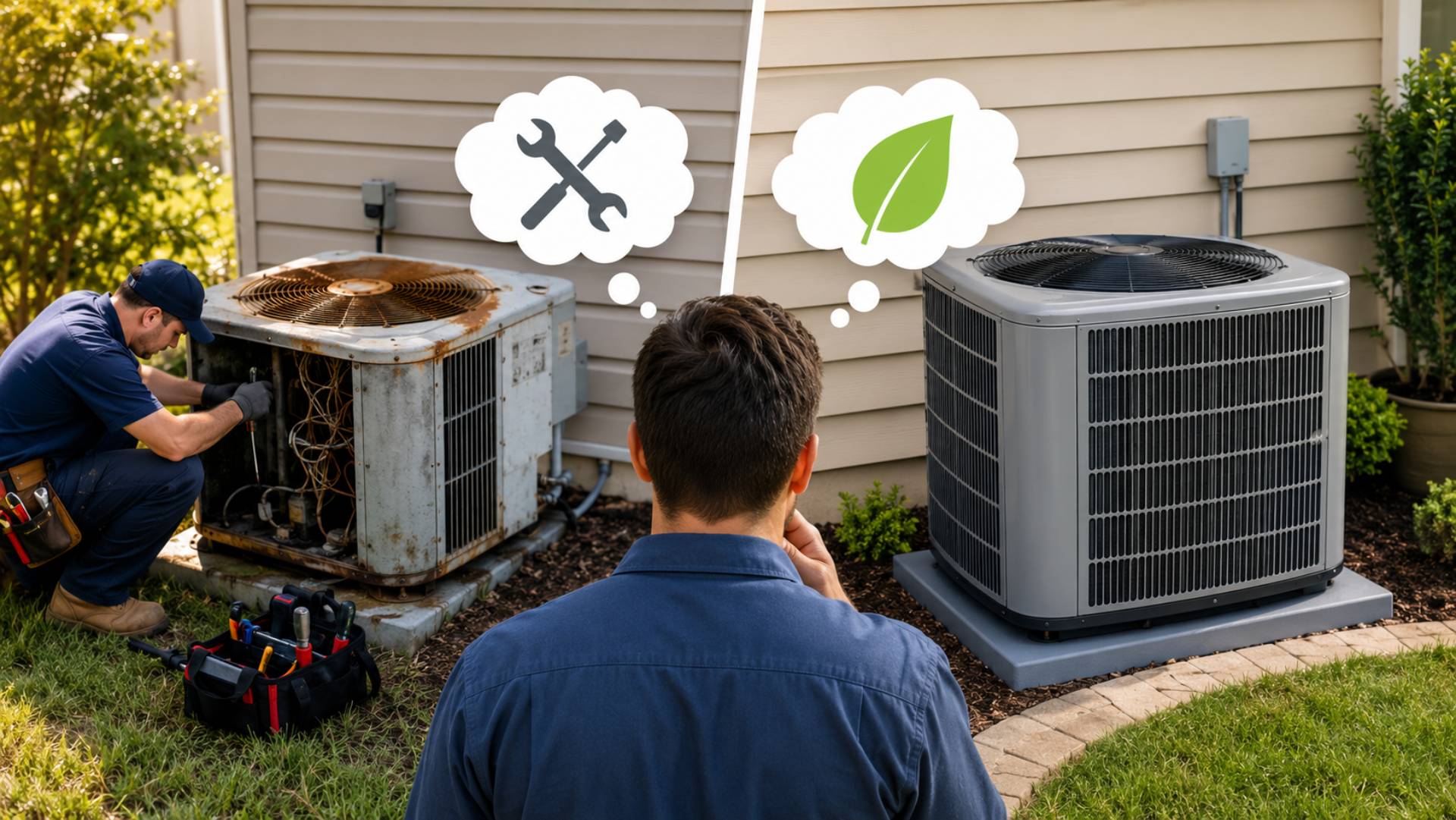
When an air conditioner starts needing repairs more often, the same question eventually comes up: should you repair it again or replace it?
There is no single age or repair-cost rule that works for every system. A relatively young air conditioner with one failed component may be worth repairing, while an older system with repeated breakdowns, rising energy bills and declining comfort could make replacement the more sensible long-term choice.
The right decision comes from looking at the complete picture. System age, repair history, efficiency, refrigerant, parts availability, comfort and future plans for the property all matter.
Start With the Age and Condition of the AC
Age is an important starting point, but it should not be the only deciding factor.
An air conditioner that has been properly maintained may continue operating reliably for years. On the other hand, a poorly maintained system may develop expensive problems much sooner.
Ask yourself:
- How old is the system?
- Has it been regularly serviced?
- Has performance declined recently?
- Are breakdowns becoming more frequent?
- Is the equipment showing signs of corrosion, damage or excessive wear?
If the system is relatively young and the current problem is isolated, a professional repair may offer good value.
An older system with several developing problems deserves closer consideration before money is spent on another repair.
Look at Your Repair History
One repair does not necessarily mean an air conditioner is reaching the end of its useful life.
For example, replacing a failed capacitor or another individual component may restore a younger system to reliable operation. The situation is different when several expensive repairs have occurred within a short period.
Keep track of:
- Previous repair costs
- Frequency of breakdowns
- Components that have failed
- Emergency call-outs
- Recurring problems
- Maintenance expenses
A pattern of repeated failures can indicate that the system is becoming less economical to maintain.
Instead of asking, “Can this be repaired?”, ask a more useful question: “How much longer can I reasonably expect this system to operate reliably?”
Consider the Cost of the Repair
Repair price should be compared with the system’s overall condition and likely future expenses.
A relatively inexpensive repair on a system in good condition can make financial sense. A major repair on an aging unit may be harder to justify if other components are also showing wear.
However, avoid making the decision based purely on a percentage of replacement cost. Rules such as “replace it when the repair costs more than half the price of a new unit” can be useful as a rough guideline, but they do not account for every situation.
Consider the repair alongside:
- The age of the equipment
- Expected remaining service life
- Recent repair costs
- Current efficiency
- Warranty coverage
- Replacement cost
- Expected future maintenance
This gives you a much more realistic picture of value.
Compare Energy Efficiency
Older air conditioners can consume significantly more energy than newer, properly sized and efficient systems.
If your cooling system still works but your electricity bills have been steadily increasing, investigate whether the equipment is losing efficiency.
Poor cooling performance can also result from issues such as dirty components, restricted airflow, refrigerant problems or incorrect system operation. Therefore, higher energy consumption does not automatically mean replacement is necessary.
A professional assessment can help determine whether the problem is repairable or whether the equipment itself has become inefficient.
When considering replacement, compare the efficiency ratings and estimated operating costs of suitable new systems rather than focusing only on the purchase price.
Think About Comfort, Not Just Cooling
An air conditioner can technically be working while still failing to provide comfortable indoor conditions.
Warning signs include:
- Rooms that remain warm
- Uneven temperatures between rooms
- Excessive humidity
- Long cooling cycles
- Weak airflow
- Frequent thermostat adjustments
- Unusual noises or odours
Some of these problems may be caused by ductwork, airflow restrictions, insulation, thermostat issues or other factors rather than the AC unit itself.
That is why a professional diagnosis matters before deciding to replace the entire system.
Check the Refrigerant Situation
Refrigerant considerations can influence the repair-versus-replacement decision.
Older air conditioning systems may use refrigerants that are being phased out or becoming more difficult and expensive to service. The exact implications depend on the equipment, refrigerant type and applicable regulations.
If your system has a refrigerant leak, do not simply assume that adding more refrigerant is the best long-term solution. The underlying leak should be properly investigated.
Ask the technician:
- What refrigerant does the system use?
- Is the refrigerant readily available?
- Is the system leaking?
- Can the problem be repaired reliably?
- Would replacement provide a better long-term solution?
These answers can help put the repair cost into perspective.
Consider Replacement-Part Availability
Parts availability becomes increasingly important as equipment gets older.
Manufacturers eventually discontinue certain components. When parts become difficult to source, repairs can take longer and cost more.
This can be particularly frustrating when an air conditioner fails during a period of extreme heat.
Ask whether replacement components are readily available and whether the manufacturer still supports the model. A system that can be repaired quickly and affordably may be worth keeping, while an obsolete unit with hard-to-find parts could make replacement more attractive.
Review Your Warranty
Before paying for a major repair or replacement, check your warranty documentation.
Depending on the equipment and warranty terms, certain components may still have coverage. Labour, however, may be treated separately.
Find out:
- What parts are covered?
- How long does coverage last?
- Is labour included?
- Are there conditions that affect coverage?
- Is the warranty transferable if the property is sold?
Warranty coverage can significantly change the financial calculation.
Think About How Long You Will Stay in the Property
Your future plans also matter.
If you expect to remain in the property for many years, investing in a reliable, efficient replacement may provide greater long-term value.
If you are planning to move soon, a major replacement may require a different financial calculation. However, an unreliable AC system can still affect comfort, running costs and the property’s appeal to potential buyers.
Think beyond today’s repair bill and consider how the decision fits your plans for the property.
Two Common Scenarios
Scenario 1: A Younger System With One Failed Component
Imagine an air conditioner that is only a few years old. It has been maintained properly, cools the property evenly and has no history of major problems.
A single component has failed and the repair is reasonably priced.
In this situation, repair is likely to be the practical first choice. Replacing an otherwise healthy system simply because one component has failed may not provide good value.
Scenario 2: An Older System With Repeated Problems
Now consider an older system that has required several repairs recently. Cooling performance is declining, energy consumption is increasing and replacement parts are becoming harder to find.
Another significant component has now failed.
Here, replacement may be the more sensible long-term option. Continuing to repair the system could result in further expenses without addressing its overall age, efficiency and reliability.
Get a Professional Assessment Before Deciding
One of the biggest mistakes homeowners can make is deciding between repair and replacement without understanding the actual condition of the equipment.
A qualified HVAC professional can inspect the system, identify the immediate fault and assess broader issues affecting performance.
Ask for a clear explanation of:
- The problem and its cause
- Recommended repair
- Repair cost
- Condition of other major components
- Current system efficiency
- Expected future reliability
- Replacement options
- Estimated replacement cost
- Warranty information
Ideally, obtain a detailed replacement estimate if the system is older or experiencing repeated failures. This lets you compare the repair with a realistic alternative.
A Simple Repair-or-Replace Checklist
Before making your decision, consider these questions:
| Factor | Repair May Make Sense | Replacement May Make Sense |
| System age | Relatively young | Older equipment |
| Repair history | One-off issue | Frequent breakdowns |
| Repair cost | Reasonable | Major expense |
| Efficiency | Still performing well | High energy consumption |
| Comfort | Consistent cooling | Uneven or inadequate cooling |
| Parts | Easily available | Difficult to source |
| Refrigerant | Readily serviceable | Increasingly problematic |
| Warranty | Coverage available | Little or no coverage |
| Future plans | Shorter-term needs | Long-term property use |
This checklist should support the decision rather than replace professional assessment.
Don’t Ignore Preventive Maintenance
Whether you repair or replace your AC, maintenance remains important.
Regular professional servicing can help identify developing problems before they become major failures. Homeowners should also follow the manufacturer’s recommendations and keep accessible components clean and unobstructed.
Good maintenance can support:
- Better cooling performance
- Reliable operation
- More consistent comfort
- Improved efficiency
- Earlier detection of problems
- Potentially longer equipment life
A replacement system also needs proper maintenance. Buying new equipment does not eliminate the need for ongoing care.
Frequently Asked Questions
Is it better to repair or replace an old air conditioner?
It depends on the system’s age, condition, repair history, efficiency, refrigerant situation, parts availability and expected future use. Age alone should not determine the decision.
How do I know if an AC repair is worth the money?
Compare the repair cost with the system’s overall condition and likely future repair expenses. A single affordable repair on a well-maintained system may be worthwhile, while repeated expensive repairs on an aging unit may point towards replacement.
Does a more efficient AC always justify replacement?
Not necessarily. A new system may reduce energy consumption, but the potential savings should be compared with the purchase and installation cost. A professional assessment can help determine whether replacement is financially sensible.
Should I replace an AC that still works?
Not automatically. If the system is reliable, efficient and providing good comfort, continuing to use it may be reasonable. Replacement becomes more attractive when performance, efficiency, reliability or parts availability are declining.
What should I ask an HVAC professional before replacing my AC?
Ask what caused the current problem, whether it can be reliably repaired, the condition of the major components, the expected future reliability, available replacement options, estimated installation cost and applicable warranty coverage.
Conclusion
Choosing between air conditioner repair and replacement is ultimately a long-term decision, not simply a response to today’s breakdown.
A relatively young, well-maintained system with an isolated fault may be worth repairing. An older unit with repeated failures, poor efficiency, declining comfort and difficult-to-source parts may make replacement the stronger investment.
The most practical approach is to look at the whole system rather than one repair bill. Consider its condition, operating costs, reliability, refrigerant, warranty and your plans for the property. Then compare the repair with a realistic replacement estimate.
When the decision is unclear, a professional system assessment can provide the information needed to make a confident choice.